
Lying in Grief: The Iconic Images of Widows at Arlington National Cemetery
In the hush of Arlington National Cemetery, where rows of white headstones stretch in solemn formation across a sea of green, moments of personal grief unfold with heartbreaking intimacy. Among the most enduring and emotionally powerful images to emerge from this sacred ground are photographs of widows—young women lying on the graves of their fallen husbands. These images, raw and unguarded, speak volumes about love, sacrifice, and the human cost of war.
Two such photographs, taken years apart but echoing the same profound grief, have captured the world’s attention. They are not staged or stylized, but stark representations of mourning—quiet, desperate, and deeply human.
1. Mary McHugh and Lt. James J. Regan (2007)
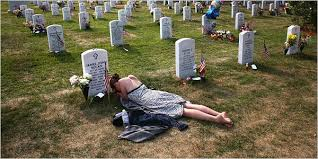
On Memorial Day in 2007, photojournalist John Moore was photographing Section 60 of Arlington National Cemetery—the area designated for those killed in the wars in Iraq and Afghanistan. It was there he encountered Mary McHugh, sitting alone beside the grave of her fiancé, Army Ranger Lt. James J. Regan, killed by a roadside bomb in Iraq just months earlier.
Mary, a civilian, knelt beside his grave and began speaking softly to the headstone. As Moore continued to observe, she eventually laid her body across the grave, as if reaching for the man just beneath the surface of the earth. Her hair fell over her face, and one hand gently gripped the cold marble of the marker bearing James’s name.
“It was a moment of private grief in a very public place,” Moore later said. “I kept a respectful distance, using a telephoto lens. I knew this was a powerful image, but it was also incredibly personal.”
Lt. Regan was 26 years old. A Duke University graduate and lacrosse star, he had turned down lucrative job offers to serve in the military. His choice to re-enlist with the 3rd Battalion, 75th Ranger Regiment, and his death in February 2007, made him a symbol of quiet heroism. Mary McHugh’s grief—so tender, so visible—became a mirror for a nation grappling with the cost of two long wars.
2. Laureen Lopez-Berry and Staff Sgt. Richard Berry (2014)

In 2014, another image made its way around the world—a woman named Laureen Lopez-Berry, lying face-down on the grave of her husband, Staff Sgt. Richard Berry, at Arlington. Captured during Memorial Day weekend, the photograph was taken by Christopher Stevens, a former Army combat photographer and veteran of the Iraq War.
Richard Berry had been killed in Afghanistan by an improvised explosive device, leaving behind his wife and young children. In the photo, Laureen’s body is draped across the grass, arms outstretched across the gravestone, as if in an embrace. Her pose evokes a mixture of helplessness, longing, and utter devastation.
Unlike the photograph of Mary McHugh, this image was captured from a closer distance. It spread quickly online, prompting an outpouring of emotion from viewers, many of whom saw in Laureen a representation of their own losses.
“That moment wasn’t posed,” Stevens later told reporters. “It was her moment, and I just happened to be nearby. I wanted people to see what grief really looks like.”
The photo brought renewed attention to the human toll of the Global War on Terror—an emotional reality that statistics alone can never capture.
3. A Quiet Moment of Mourning at Arlington National Cemetery

In this powerful and deeply emotional image, an unidentified woman lies on a blanket beside the grave of a fallen soldier, believed to be her partner or husband. Next to her, a baby—perhaps their child—rests in a car seat, cradled in quiet innocence amid the solemn rows of headstones. Surrounded by flowers, an American flag, and personal belongings, the scene captures a profoundly intimate moment of grief, love, and remembrance. Though her name remains unknown, this woman’s quiet vigil speaks volumes about the enduring cost of war and the families who carry its weight long after the battles have ended.
Respecting Grief in Public
These photographs transcend the boundaries of photojournalism. They function as:
- Memorials: Each image becomes a stand-in for a life interrupted—and for the quiet heartbreak left behind.
- Cultural artifacts: They reflect the evolving experience of military service in an age of asymmetrical war and prolonged deployments.
- Emotional documents: They give voice to those who often remain invisible—military spouses and families whose grief unfolds away from battlefields.
At a time when media coverage of war can feel distant or abstract, these images cut through the noise. They are not about troop movements or policy—they are about people.
Both photographers have emphasized the ethical considerations of capturing such private moments. Moore, for example, said he hesitated before releasing the image of Mary McHugh, ultimately deciding that the image honored, rather than exploited, her grief. Likewise, Christopher Stevens sought Laureen’s permission before sharing the photo widely.
In both cases, the women later expressed support for the public sharing of their images, hoping it might help others understand the real cost of service.
Conclusion: Love, Loss, and the Legacy of War
The images of Mary McHugh and Laureen Lopez-Berry lying on the graves of their soldier husbands are more than portraits of sorrow—they are portraits of love. They remind us that behind every name etched in marble is a life once lived, and a web of lives forever altered by loss.
In capturing the grief of these women, photographers like John Moore and Christopher Stevens have given the world something rare: a window into the soul of sacrifice. These photographs do not glorify war. They humanize it.
And in doing so, they ask us to remember—not just the fallen, but those left behind.
